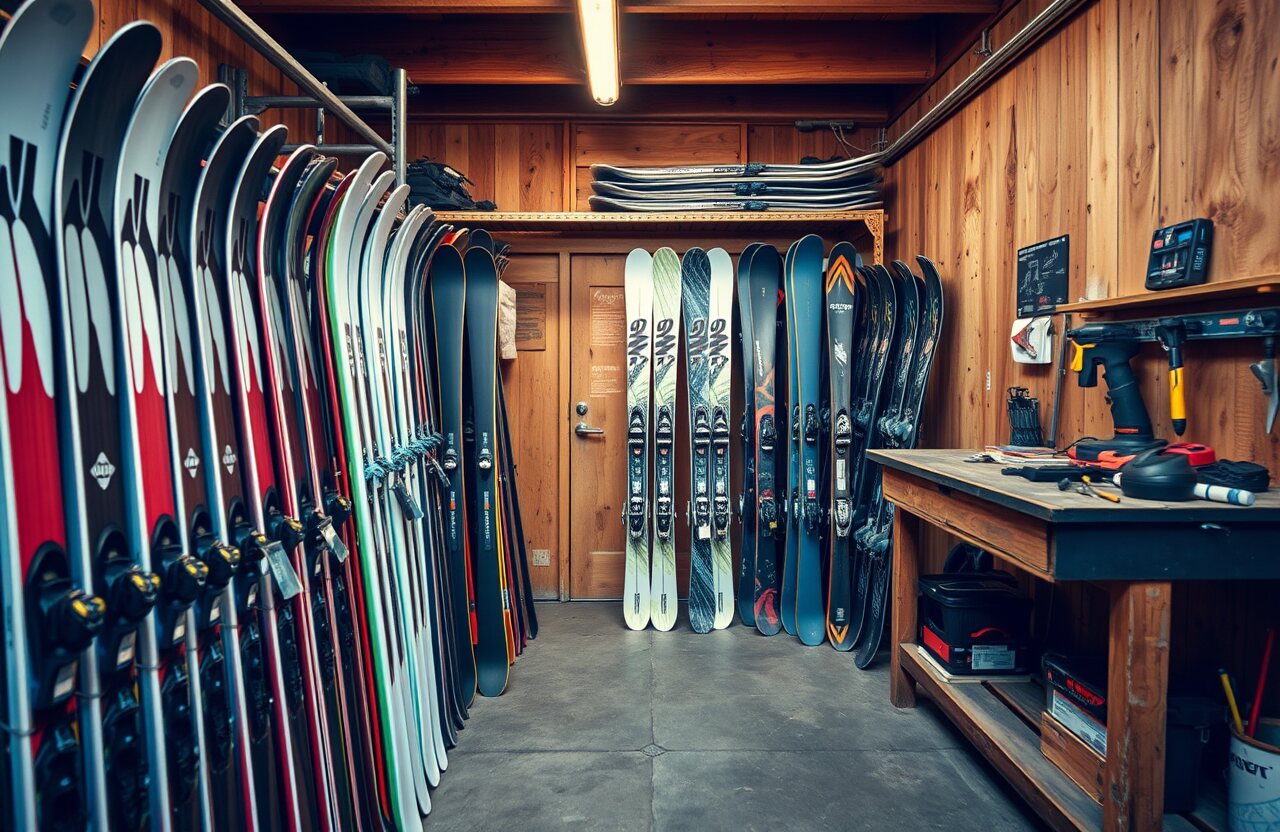
The Seasonal Problem
Run a ski shop, a restaurant, a guide service, a property management company or a gallery in Telluride and your year has a shape almost no insurance product assumes: a violent ramp in November and December, a peak that runs through the ski season, a shoulder-season collapse, a summer festival surge, and a mud season where the doors may not open at all.
That shape creates specific exposures — a payroll that swings by multiples, staff hired fast and trained fast, buildings that sit empty for weeks, and equipment that goes out the door with the public. Most of the coverage failures we see in ski towns are not exotic. They are the ordinary policies applied to an extraordinary calendar.
Workers' Compensation: The One With No Threshold
This is the requirement that catches new and seasonal employers most often, and the rule is unusually blunt.
The Colorado Division of Workers' Compensation states it plainly: if you have one or more employees working for you in Colorado, you must have workers' compensation insurance and maintain it at all times — and this applies to all employers regardless of whether the employees are part-time, full-time, or family members.
There is no headcount threshold. No payroll minimum. No waiting period. No seasonal exemption. The lift operator you hired for eleven weeks counts the same as a year-round salaried manager.
A few related rules that matter to a seasonal operation:
Anyone you pay is presumed to be an employee. Colorado law starts from the presumption that a person paid for services is an employee, subject to specific independent-contractor exemptions. "They're a 1099" is a conclusion you have to earn, not a label you can apply — and misclassifying seasonal staff is one of the more expensive mistakes available.
You pay all of it. The premium is entirely the employer's obligation, and no portion may be deducted from wages.
Coverage is always obtainable. You can buy from a commercial carrier or qualify to self-insure, and Pinnacol Assurance is required to provide coverage for any Colorado employer. There is no "nobody will write us" outcome here.
The penalties are structured to hurt. Operating uninsured can draw fines of up to $500 per day, and the business can be shut down. Worse: if a worker is injured while you are uninsured, you pay the claim yourself, plus a penalty of 25% of the injured worker's benefits. For a seasonal business, a single serious injury in an uninsured month can be an extinction event.
If you use contractors, you have an extra duty. In construction, you must either provide your contractors workers' comp coverage — and you may charge them their share — or obtain proof of coverage, or a filed rejection of coverage, from everyone you contract with directly. A contractor with no employees must be covered unless they have formally rejected coverage. Verification tools are published by the Division; use them and keep the records.
Administrative duties that are easy to skip and easy to prove you skipped: post the Notice to Employer of Injury poster (WC 50), keep a record of lost-time injuries and occupational diseases, report injuries to your carrier within 10 days, maintain a designated provider list, and file the Supplemental Report of Return to Work.
Handling the Payroll Swing
Workers' comp premium is driven by payroll and by class code. A business whose payroll quadruples for four months and then collapses has two practical concerns:
Estimate honestly, and update mid-term. Premium is set on estimated payroll and trued up by audit. Understating your seasonal payroll does not save money — it defers it into an audit bill that arrives in mud season, which is the worst possible cash-flow timing.
Get your class codes right. A retail clerk, a ski technician in a tuning shop, and a guide taking clients into the backcountry are not the same risk and should not be coded the same. Both over- and under-classification cost you: one inflates premium immediately, the other produces an audit adjustment and an argument.
General Liability: What It Does and Does Not Reach
Commercial general liability responds to third-party bodily injury and property damage — the customer who slips on the meltwater tracked into your entryway, the ski that falls off a wall rack, the damage your crew causes in someone's home.
For a ski-town business, three GL questions matter more than the rest:
Is your operation actually described correctly? A retail shop that also rents equipment, or also tunes it, or also runs a guided tour, is doing several different things. Coverage follows the operations described on the policy. Add a service and forget to say so, and you have an argument at claim time.
What are your contractual obligations? Landlords, ski areas, event organizers, and municipalities all commonly require specific limits and additional-insured status. Read the requirement before you sign the lease or the vendor agreement, not after — meeting a limit you already agreed to is straightforward, discovering you cannot is not.
Where does participant injury sit? This is the big one for anything recreational, and it is covered below.
"How Much Does a $1,000,000 Liability Policy Cost?"
This is the most-asked question and the one that cannot be answered honestly with a number. Premium depends on your class of business, revenue, payroll, claims history, the limits and deductible you choose, and how much of what you do is participant-facing. A gallery and a heli-accessed guide service both buy "a million dollars of GL" and pay wildly different premiums for it, because they are not selling the same risk.
What is worth saying: for most small ski-town businesses, general liability is not the expensive line. Workers' compensation and, where applicable, participant liability usually are.
Is It Illegal to Run a Business Without Liability Insurance?
In Colorado there is generally no statutory requirement that a business carry general liability insurance — unlike workers' compensation, which is mandatory from the first employee. But "not illegal" is doing very little work here. Your lease almost certainly requires it, your vendors and event organizers will require it, a ski area or land manager will require it, and going without means personal exposure to a claim that GL exists to absorb. And forming an LLC does not solve this: an LLC can limit certain liabilities, but it does not pay a claim, and it does not stop a plaintiff from pursuing the business's assets — which are your assets in a small operation.
Liquor Liability: Colorado's Dram Shop Rules
If you serve alcohol, Colorado's dram shop statute is C.R.S. § 44-3-801, and it is narrower than most operators assume.
The standard is willful and knowing. A licensee is liable only if it "willfully and knowingly sold or served any alcohol beverage to a person who was under the age of twenty-one years or who was visibly intoxicated." Ordinary negligence is not the test.
The clock is short. A civil action under the statute must be commenced within one year after the sale or service.
Damages are capped, and the cap moves. The statutory limitation is adjusted every two years for inflation and certified by the Secretary of State. For claims accruing on or after January 1, 2026 and before January 1, 2028, the cap is $465,730 (up from $437,880 for the prior two-year window).
Is liquor liability insurance mandatory? The statute caps liability; it does not require coverage, and we found no state-level mandate. But Colorado is a dual-licensing state — you hold both a state and a local license — and local licensing authorities can impose their own insurance requirements. Confirm what the Town of Telluride or Town of Mountain Village licensing authority requires for your license type rather than assuming the state answer is the whole answer.
Practically: a $465,730 cap describes the statutory dram shop claim. It does not cap everything that can arise from an over-service incident, and a defense costs money whether or not you ultimately owe anything.
Outfitters and Guides: Registration Comes With Insurance Minimums
If you run guided activities, Colorado regulates you directly. Registration is required through the Office of Outfitters Registration at the Department of Regulatory Agencies, under C.R.S. Article 12-145.
To be issued a registration, C.R.S. § 12-145-108 requires that you:
- hold a valid first aid card or first aid instructor's card from the American Red Cross, or evidence of equivalent training;
- carry minimum liability insurance of $50,000 for bodily injury to one individual in a single accident and $100,000 for bodily injury to all individuals in a single accident; and
- post a surety bond of at least $10,000 from a surety authorized in Colorado.
Separately, C.R.S. § 12-145-112 requires written contracts for outfitting services.
Read those insurance minimums as a floor, not a target. $50,000 per person is a legal registration requirement, not a realistic assessment of what a serious backcountry injury costs. Federal land agencies issuing special-use permits, and sophisticated corporate or destination-wedding clients, routinely require substantially higher limits than the statute — confirm the specific requirement in your permit or contract, because that number, not the statutory minimum, is the one you actually have to meet.
Guided operations should also be looking hard at participant legal liability — general liability policies commonly limit or exclude injury to the very participants you are guiding, which is a strange thing to discover after an accident.
The Coverages Seasonal Operators Forget
Business interruption, sized to a season. A standard BI calculation assumes a business that earns evenly. Yours does not. A fire that closes you for six weeks in July and a fire that closes you for six weeks in February are entirely different financial events. Make sure the coverage and the period of restoration reflect when your revenue actually happens.
Vacancy and off-season conditions. A building closed through mud season is subject to the same freeze and burst risks as an empty house, and commercial policies contain conditions about unoccupied premises. Know what your policy requires you to do while you are closed — heat maintained, water shut off, periodic checks.
Property in your care. Customer skis in your tuning shop, gear in your rental fleet, artwork on consignment, equipment out on rental — this is bailee or property-of-others exposure, and it is not automatically covered by your building and contents limits.
Off-premises and in-transit. Gear on a trailer, a rental fleet moved to a satellite location, equipment at a festival booth. Coverage tends to be tied to a described location unless you extend it.
Employment practices. High-volume seasonal hiring, young staff, employer-provided housing, and compressed training create employment exposures that a GL policy does not touch.
Hired and non-owned auto. Staff running errands or shuttling guests in their own vehicles is a real and commonly uninsured exposure.
A Pre-Season Checklist
- Workers' comp bound before the first seasonal hire starts, with an honest payroll estimate and correct class codes.
- Every operation you actually perform listed on the GL policy — including the ones you added last season.
- Certificates and additional-insured endorsements matching what your lease, permits, and vendor contracts require.
- Liquor liability reviewed against your local licensing authority's requirements, not just the state's.
- Outfitter registration current, with limits that meet your permit and client requirements rather than only the statutory floor.
- Business interruption sized to your seasonal revenue curve.
- Off-season vacancy conditions understood and actually followed.
The Bottom Line
Almost none of this is exotic. It is the ordinary commercial insurance program, adjusted for a business that makes most of its money in a few months and then goes quiet — and checked against the handful of Colorado rules that have no small-business exemption. Workers' compensation is the one with genuinely no room for interpretation: one employee, any hours, coverage required, penalties structured to make going without unaffordable.
Request a commercial coverage review online, or call 844-967-5247, and we will walk your operations, your seasonal payroll curve, and your permit and lease requirements against what you are actually carrying.